Building for One, Part one: a calm iPad display for someone living with dementia built a calm daily tablet display for someone in the early stages of dementia, Building for One, Part five: everybody reads it before she does got it into three app stores, and Building for One, Part six: four names for one app was about what to call it. This part is the first of a few shorter pieces, written now that it has been in daily use for a month, about what it is doing in the house rather than how it was built.
It is about the question we are asked most often, which is whether a timetable on a screen is not a bit regimented for somebody with dementia. It is the right question, and answering it turned out to be the whole design.
TL;DR – Structure is what a day looks like from inside it. A regime is what it looks like to whoever is checking. We think the display works because it gives her the first and refuses, at every turn, to become the second.
Contents
- Two things that look the same
- What a shape looks like on a screen
- The gap is the test case
- What it declines to say
- It speaks, but it does not summon
- The household’s words, the household’s shape
- Where the structure actually lives
- What it is doing in the house
- Getting it, and telling us where we went wrong
Two things that look the same
The family’s existing habit, before there was an app, was a paper chart in the hall: a green tick or a red cross against each meal and each set of tablets, marked by whoever visited. It is a perfectly good chart. It is also two different things depending on who is looking at it.
To the person holding the pen it is structure. It says what the day contains and lets three or four people who are never in the house at the same time share one picture of it. To the person it is about, it is a regime: a record of compliance, in colour, on the wall, with the red ones still there at bedtime.
Most software for organising a day is built for the person holding the pen, and it shows. Streaks, badges, overdue states, red counts, escalating nags. Those are a regime that people choose for themselves, and there is nothing wrong with choosing one. She did not choose this, and the thing a regime would keep score of is precisely the thing that is failing.
So the question we kept coming back to was not “how much structure” but “where is the line”. What is the least a screen has to do to answer the question she is actually asking, and what is the first thing that tips it over into keeping score? The line turned out to be sharper than we expected, and nearly every decision below is a case of finding it.
What a shape looks like on a screen
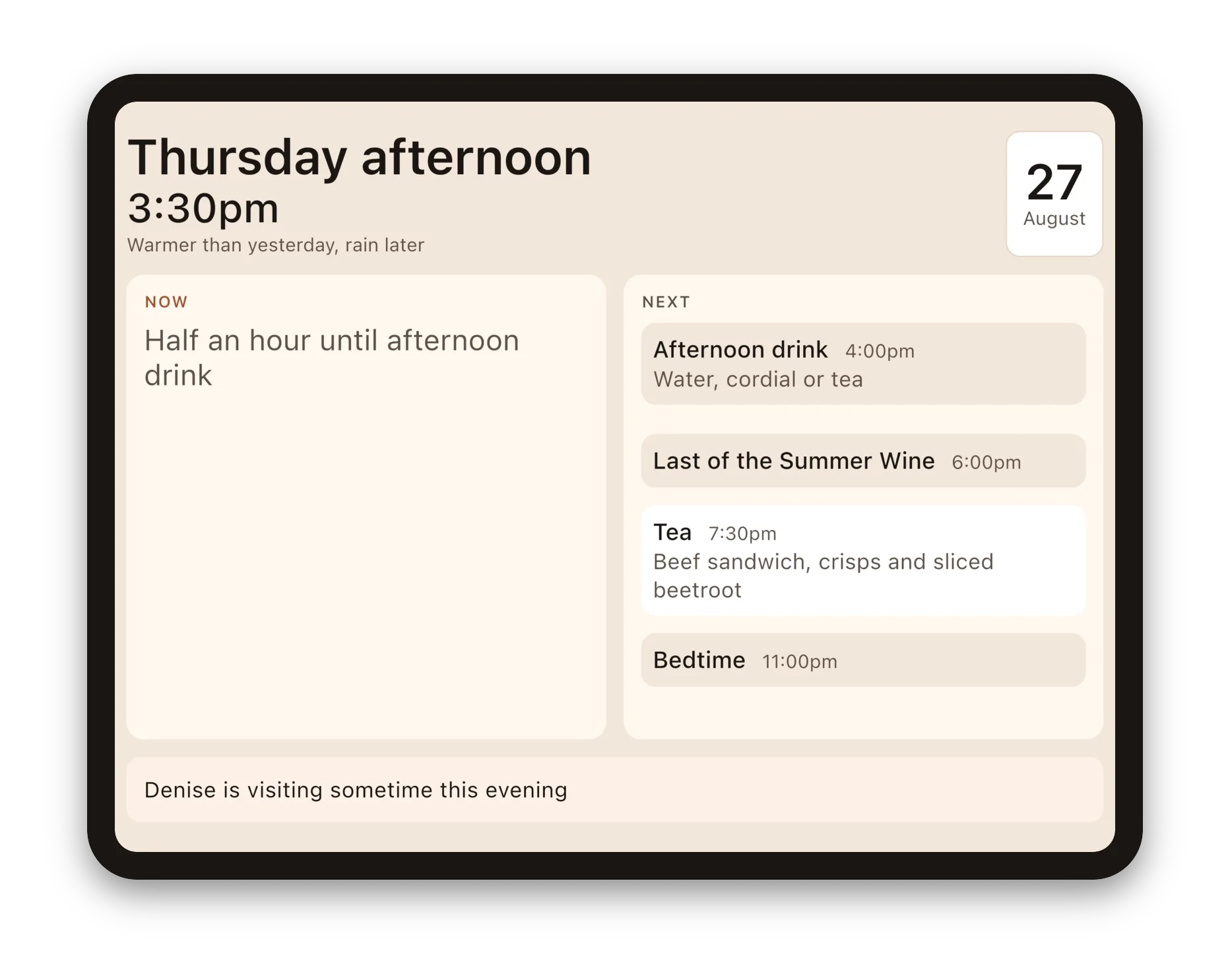
The two slots never move. What is happening now sits on the left, under NOW. What is coming sits on the right, under NEXT, nearest first. Nothing is ever promoted from one to the other, and nothing borrows space from the other side. The screen at eleven in the morning is the same screen as at four in the afternoon, with different words in it. She never has to learn it twice, and we think that is most of what makes it readable at a glance from across a kitchen.
The thing comes first and the time second, everywhere. “Tea, 7:30pm”, never “7:30pm, Tea”. This is a display about what happens in a day rather than when, which is the whole difference between it and a calendar. A calendar is a grid of times you are expected to be somewhere. This is a list of things that will come to her, in order, and the time is a detail on each one.
One card, one order, one shape. Whatever is happening, whatever is next, and every line of the rest of the day use the same card with the same internal order: the thing, the time beside it, what it is underneath. Meals are raised, white on the cream page, because meals are the fixed points a day is built around. Everything else sits back into the ground tone. The eye learns the pattern once and after that only has to read. Every different shape on a display like this is something to parse, and parsing is what we are trying to spare her.
The gap is the test case
Most of a day is the space between things, and what a screen does with that space is where the line between structure and a regime shows most clearly.
A timetable names the gap. “Free time”, “Rest”, “Quiet period”. It looks harmless and it is not, because it is the display having an opinion about how she spends her own afternoon. She is usually watching television or doing a jigsaw, and she needs no instruction about it from an iPad. The one thing she cannot work out for herself is how long she has. So that is the one thing it says.
The gap is described, never named. “Half an hour until afternoon drink”, in quiet text with no card around it, because a card is for a thing with a time on it and a box around nothing is still a box around nothing. If two things start together it names both, so that the sentence answers the whole of the question she asked.
And it says half an hour, never thirty-four minutes. Half an hour is a quantity of time a person feels. Thirty-four minutes is a number to be converted into one first, and the conversion is work. Between the landmarks it says “less than” the next one up, which is how it would be said aloud and is never an overstatement. There is a test that walks every minute from now to five hours away and checks the screen never promises her something sooner than it comes. A person kept waiting past what a screen told them has been let down by it, and this display cannot afford to let her down even once.
We think this is the clearest single example of the distinction. A regime counts in minutes because minutes are what it keeps score in. A shape rounds to what a person would say.
What it declines to say
The first rule, written before any code, is that nothing on her screen ever reports a failure. No red, no “missed”, no “overdue”, nothing struck through. Anything whose time has passed simply drops off the display, and whether it was done is information for the people looking after her, not for her. She cannot fall behind, because there is nothing on the screen to fall behind on.
The Done button was the hinge. Part one tells the story of building one and taking it off, so only the moral is worth repeating here. Her tapping is unreliable in both directions: she may tap without doing, or do without tapping, so the signal is noise wearing the costume of data. A checkbox invites a wrong answer and then remembers it. And it was the only tappable thing on a display whose entire premise is that there is nothing to tap.
What we understood in taking it off is that the tick is the exact point at which structure becomes a regime. The moment a screen can record that you did or did not, it is keeping score, and a screen keeping score on somebody with dementia is a screen telling them, day after day, that they are getting worse. There is no gentle way to phrase that. The only kind way is not to have the tick.
The tick still exists. It belongs somewhere else. Where it belongs is with the carers, once there is somewhere for it to live, and worded as what it is: “Sarah marked breakfast done at 10:52”, never “breakfast taken”. The structure and the record are for two different people, and we think the mistake most products in this space make is putting them on the same screen.
It speaks, but it does not summon
A day clock that only works when she happens to glance at it is doing half the job, so the display makes a sound when something starts. Getting the sound right was a surprisingly large part of keeping the line.
One low bell. Not a doorbell, because a doorbell heard in her own front room is a reason to get up and answer the front door. Not a telephone, because that is a reason to go looking for the phone. Not a thin high ping, which is the sound she would be least likely to hear and the most likely to read as an alarm if she did. A bell she has not heard anywhere else means nothing except “look at the screen”, which is the whole of the message.
It sounds for meals, drinks, tablets, and somebody coming. It does not sound for the shape of the day. “Morning” at eight is not a thing to be called to. It is the day beginning. Twelve chimes between getting up and bed would be a regime with a bell on it, and each item can be switched on its own so a household can have as few as it likes.
One sound, however many things start together: two chimes a second apart is a fault rather than twice the information. It plays through silent mode, deliberately, because whether she is called to lunch should not be decided by a setting nobody remembers. It does not stop the radio she has on.
And nothing happens if she ignores it. It does not repeat, it does not escalate, and the screen looks exactly the same afterwards. We think the difference between a bell and an alarm is mostly whether anything happens if you ignore it, and here nothing does.
The household’s words, the household’s shape
A regime comes with a template. A shape is whatever the house already does, written down.
The eight o’clock item on her display is called “Morning”, not “Wakes up”, because that is what a person says. “Tea” is at half past seven and it is a sandwich. The first real routine we have runs: morning at eight, up and dressed at a quarter to ten, coffee at a quarter past, breakfast at half past ten, lunch at one, an afternoon drink at four, dinner at half past seven, bed at eleven. It looks nothing like the three-meals-at-sensible-hours household that a template would assume, and nothing in the app assumes one. There is no fixed number of meals, no fixed names for them, and no idea of which one is the big one. A household’s meals are simply the things it eats, named by the family.
The week has a shape too. The cleaner on Monday, help with a shower on Tuesday, the shopping delivery on Thursday. A day with somebody coming to it is a different day, and the difference matters out of all proportion to the size of the entry. The structure here is that the display knows which day it is. The regime it avoids is expecting her to.
The note takes itself down. “Sarah is coming this afternoon” is quietly wrong from about five o’clock, and a note left up past its time is worse than no note at all, because it is the one thing on this screen capable of making her wait for somebody. So a note is written with an expiry, in the four words a person would actually use: this morning, this afternoon, this evening, today. It is an expiry rather than a window, because the note has to be up all morning as well. Answering “is anybody coming today” before it happens is most of what it is for.
Where the structure actually lives
None of this means the structure is vague. It is precise, and it is somewhere else.
Behind five taps in a corner and a PIN is the family’s half of the app: the routine, set once and then mostly left alone; the meal lists, which are what this household actually eats; and meals for the week, which is the job that changes daily. A carer standing at the freezer holding something cold can swap tonight’s tea in about four taps, from a list the family has already approved. That surface is deliberately a different colour, a different type size, and a different shape from her display, so that nobody can mistake one for the other from across a room, and it puts itself away after half a minute so it can never be left open on her iPad.
That separation is what lets one half be firm and the other be soft. The routine can be as exact as the family likes, to the minute and to the day of the week. What reaches her is only ever what is happening, what is next, and how long until it. The display is not where the structure is made. It is where it shows.
We do not think any of this is a discovery. Anybody who has looked after somebody knows the difference between a house with a rhythm and a house with rules, and would probably have described it better than we have. What surprised us was how many software defaults push you towards the rules. The tick, the badge, the overdue state, the minute-accurate countdown, the notification that repeats until dismissed. Each is a line of code, each is the obvious thing, and each one, on this screen, would be a small betrayal.
What it is doing in the house
It has been on her iPad for about a month, and we are careful not to claim more than we can see.
What we can see is that she reads it, that she has not asked for it to be explained, and that the two things she has said she likes are that it knows her menu and that it tells her whether today is warmer or colder than yesterday. Nothing on it, as far as anybody has noticed, has made her anxious. For a thing with no buttons, no ticks, and nothing to get wrong, that is close to the entire success criterion, and it is the one we would most like to hear about from other households.
Getting it, and telling us where we went wrong
It is out on all three stores now. The App Store, Google Play, and the Amazon Appstore, and daysome.org carries the links to each. It installs like any other app, it is free, and you can stop whenever you like.
We would still like to hear from you, and that matters to us more than an install does. If you support someone in the early stages of dementia who is still living independently, or you work in dementia care and would be willing to tell us plainly where we have got it wrong, that is the thing we cannot get any other way. In particular we would like to know whether the day on the screen is the day the person actually recognises, and whether anything on it makes them feel watched, corrected, or managed. Those are not things we can test. daysome.org/testers.html is the place to tell us.
Plainly, so nobody is misled: Daysome is an app centred on a display that shows the day. It is not a medical device, not a monitoring system, and not a substitute for anybody. It does not track whether medication has been taken, and it never will.