Multizone | All our technotes
If we've published it, you can find it here.

GNU ddrescue for hard disk imaging or recovery on macOS Ventura
GNU ddrescue (ddrescue) is a proven data recovery tool which you can trust. However, it is also quite a complicated command line tool. If only there was a way to make it more straightforward to use.
- Details

It is great to see the fruit of Ubuntu's decision to embrace Flutter. App Center made it into Ubuntu 23.10 but properly cements itself into 24.04 as a flagship app. 24.04 is an LTS release, so this is a long term bet.
TL:DR — This is a massive endorsement of Flutter for Linux by Ubuntu.
- Details

If you don't need a full scale data centre style virtualisation solution but need a local lab environment then Workstation Player uses VMware vSphere Hypervisor technology to provide simple and secure local virtualisation on modest hardware. It is far easier for a small local testing or technology exploration lab than ESXi or OpenStack and VMware’s decision to make VMware Workstation and VMWare Fusion free for all users makes it simple.
Why VMware Workstation?
VMware Workstation supports hundreds of 32-bit and 64-bit guest operating systems. Best of all, VMware Workstation Player is now free for all uses. You might also want to review Moving VMware Mac Fusion to PC Workstation is easy.
TL:DR — It is now easy and free to install VMware Workstation 17.6.3 on Ubuntu 24.04. YMMV.
- Details
Read more: Installing VMware Workstation Pro for Ubuntu 24.04

It is no longer hard to serve multiple differently named websites from the same server with SSL. Let's Encrypt supports Apache and Ubuntu and is easy to configure.

The Apache HTTP Server has always had a virtual hosts feature to serve multiple differently named websites from the same server. Setting it up with SSL is historically more complex than it perhaps ought to be given that the project it named after HTTP it was centred around http and https was originally an additional, often expensive and complex configuration step.
This seems outmoded to me. Even for test sites, traffic encrypted to the web browser with https is mandatory for any serious web presence. http is an insecure protocol that should really be a secondary consideration. Anyway, it is what it is.
With virtual hosts, each individual site appears to the end-user to have a different identity even though it is served from the same server. Hosting providers use this technology to provide resilience, security, scale, analytics and for many other reasons but it is also useful for developers who want to have a replica small scale development or staging environment perhaps for multiple websites. A development environment is my reason for building out Apache 2 virtual hosts with separate Let's Encrypt certificates on my Ubuntu Linux machine.
To make it work, you need to think about setting out the directory structure on your Linux machine, the Virtual Hosts configuration files for Apache2, and a properly resolving DNS record to the Linux machine hosting your virtual host site. Setting it up is easy enough but takes a little bit of concentration on the details of all these moving parts. Adding SSL to these virtual hosts is far less tricky than it once was because 'Let's Encrypt' does most of the heavy lifting now.
TL:DR — I now have two dev sites on my local Ubuntu Desktop. Both have valid Let's Encrypt SSL certificates and are working well locally and via the Internet. It took about 45 minutes to set up.
- Details
Read more: Let's Encrypt Secure virtual hosts on Ubuntu 24.04

This PC doesnt currently meet Windows 11 system requirements
So, I bought this total bargain Lenovo ThinkCentre 710q chiefly because it consumes low power, has all Lenovo's attention to detail for maintenance and spare part replacement, has a nice tiny form factor, and a reasonably modern architecture. The Think Centre supports secure boot, and has a Trusted Platform Module (TPM) 2.0. This one came with a DVD rw drive but has a modest 8GB of memory and a 500GB drive. The 6th Generation Intel® Core™ i5-6400T 'Skylake' processor and the Intel HD 530 graphics are end of life. Nevertheless it is a relatively good specification. Sadly however, according to Microsoft's tools, the Lenovo ThinkCentre M710q appears to be unable to meet the minimum system requirements for Windows 11. Thats a shame, but all is not lost! Lets see what can be done to improve the usefulness of this machine.
TL:DR — Lenovo have always made high quality rugged expandable hardware, especially in the Think design range they acquired from IBM, who after all, invented the PC in the first place. These ThinkCentre 710q tiny workstations are low power workhorses so they don't cost a fortune to run and are cheaply and plentifully available now in the used marketplaces. They can be expanded to excellent maximum specification and in some cases beyond to deliver their full potential at low cost and are ideal for home/lab/small office use. Plenty of parts are available, mostly very easily user replacable with ease. It is as easy as can be to bypass the arbitrary restriction and allow the upgrade to Windows 11, or indeed to install Linux or whatever other OS you please.
- Details
Read more: Install Windows 11 on a ThinkCentre with unsupported

Secure File Sharing with FileCloud
FileCloud is powerful software, delivering a secure, enterprise-grade file sharing and content collaboration platform. The community edition provides an annual licence for 5 full accounts, with 10 external accounts. Community edition is self-hosted on your Windows or Linux servers or in your own account in a supported Infrastructure as a Service (IaaS) provider. For our review we installed it in Amazon EC2, using Amazon S3 for storage, as well as on a local Linux server, using local storage, and on a local virtual machine, on an Intel based Mac, running VMware Fusion, with the Filecloud provided Ubuntu 22,04 virtual machine. You need to have a good knowledge of Linux, virtual machines and web applications to get Filecloud running well.
Warning for Linux installations!
After installing FileCloud, it auto updated and somehow, during this process, something recursively changed the permissions of the entire Linux machine to www-data:www-data. This is pretty much impossible to reliably recover from, so the machine had to be reinstalled. Fortunately this was a lab machine not a production machine.
FileCloud requires some very specific dependencies. The installer and the upgrade process is brittle being just a set of scripts with little or no explanation. It is made more opaque because it is not open source. These things are probably enough to make you look elsewhere, which is a shame because the functionality ticks all the boxes!
- Details

Cassette tapes are a lost art. I haven't had a cassette player connected to my home audio system for decades. But I remember vividly the playlists on my mixtapes, and still today expect certain songs to appear after other songs when I hear them. Mixtapes also provide a snapshot of the music at the time, unlike our digital media services today.
Vintage cassette players and recorders, are expensive and full of compromises on eBay but seem to have a devoted following among collectors, vinyl enthusiasts, and music lovers. Analog audio has the hiss of tape. Remember the special grades of Tape? Like mighty TDK SA 90 which was the king of the blank audio cassette for years. TDK also made C-120s but they were prone to failure and best avoided. Everybody it seemed, made Cassette media, but it was always TDK for me if I could stretch to them.
In my other article on New Cassette recorders in 2024, I look at the only two, almost identical brand new decks you can buy (from Teac and TASCAM). Both have the exact same mechanism, and remote, with a few styling differences, notably – rack mount capability and one additional playback function on the TASCAM. In the end I decide to try a second hand deck to determine how much quality I can get out of it, and really whether I care enough to invest in this old but originally groundbreaking media. I'm still a sucker for TASCAM, the professional division of Teac, so I looked for a TASCAM 302 - one of the finest professional, rack mountable, dual cassette decks ever made.
TASCAM 302
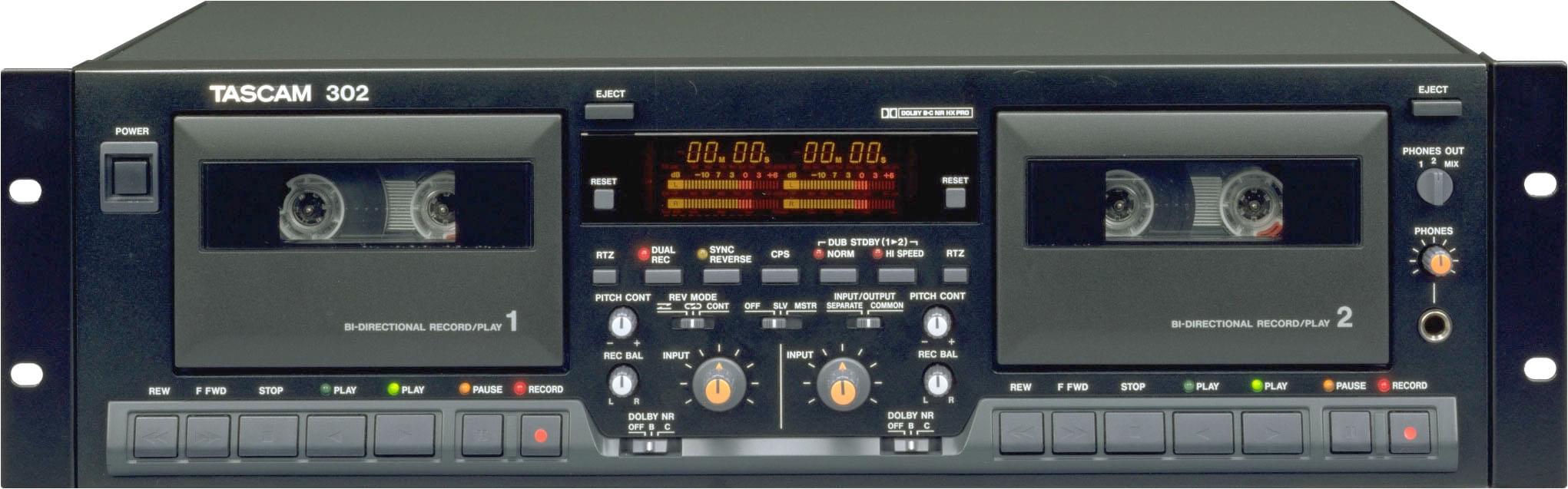
TL:DR — If you have the means theres still a TASCAM Pro Audio and a Teac consumer cassette deck available in new condition with USB out from. But can you get similar quality out of a second hand TASCAM cassette deck?
- Details
Read more: Tascam 302 Professional level Compact Cassette Deck