How the UK Emergency Alert System Works
The UK Emergency Alert system operates on cell broadcast technology, a transmission method that distributes alerts simultaneously to all compatible mobile devices within a defined geographic area. Critically, this architecture requires no knowledge of individual phone numbers or subscriber location data, meaning the system reaches users based on which cell towers their device is currently connected to rather than any stored personal information. This design provides both operational efficiency and a strong privacy assurance for recipients.
TL;DR – Some of the concerns about this technology which are outlned in our artice Really loud alert from my phone where we explainhow to opt out or switch these alrerts off, read on for more background to this technology.
Contents
- How the UK Emergency Alert System Works
- Alert Delivery and Device Behaviour
- Authorised Operators
- Accessibility and Language Provision
- From Cold War Origins to Modern Rollout
- Cold War Foundations
- Government Trials and Policy Development
- Official Launch and First Nationwide Test
- First Live Operational Alert
- The August 2026 Wildfire Alert: A Landmark Activation
- Alert Content and Public Guidance
- Operational and Policy Significance
- Implications for Emergency Management and Public Preparedness
- Lessons from Testing and Live Deployment
- Integration with Existing Warning Channels
- Responsibilities for Industry and Landowners
- Future Considerations
Alert Delivery and Device Behaviour
When an alert is broadcast, compatible mobile phones and tablets respond with a distinctive, loud siren-like sound accompanied by sustained vibration lasting approximately ten seconds. Notably, this response is triggered regardless of whether the device is set to silent mode, ensuring that alerts reach recipients even when devices are muted. Each alert message includes either a phone number or a link to the GOV. UK website, directing recipients to further guidance on the specific emergency.
Authorised Operators
The system is not open to general use. Alerts may only be issued by the emergency services, government departments, agencies, and public bodies with a designated remit for emergency management. This controlled access maintains the credibility and authority of the system, reducing the risk of misuse or public desensitisation.
Accessibility and Language Provision
The system incorporates provisions for users with sensory impairments. Where accessibility notifications are enabled on a device, audio and vibration attention signals ensure that deaf, hard of hearing, blind, or partially sighted users receive effective notification. On the language front, alerts are issued in English as standard, with Welsh language provision available for alerts distributed within Wales.
Together, these technical and operational characteristics position the UK Emergency Alert system as a robust, privacy-respecting, and inclusive mechanism for delivering life-threatening warnings to the public at scale.
From Cold War Origins to Modern Rollout
The United Kingdom's Emergency Alert system represents the culmination of decades of public warning infrastructure development, tracing its conceptual roots to Cold War-era civil defence architecture. Understanding this lineage is essential for professionals assessing the system's institutional foundations and its path to operational maturity.
Cold War Foundations
During the Cold War, the UK operated an emergency warning system known as Handel, administered by the UK Warning and Monitoring Organisation. The system was designed to alert British institutions and the public ahead of a catastrophic wartime attack, including nuclear detonation or severe bombing. The associated Wartime Broadcasting Service was tasked with disseminating the "four-minute warning" and maintaining public communications in the aftermath of such an event. The system was formally discontinued in 1992, leaving a significant gap in mass-notification capability that would take over two decades to meaningfully address.
Government Trials and Policy Development
In 2013, the UK government trialled a cell broadcast-based system comparable to those already operational in other jurisdictions, exploring how alerts could be simultaneously broadcast to multiple mobile devices within a defined geographic area. Cabinet Office findings from this period and subsequent 2014 assessments informed the technical and policy framework that would eventually underpin the modern service.
Official Launch and First Nationwide Test
The Emergency Alert system was officially launched on 19 March 2023, with the first nationwide public test conducted on 23 April 2023. This test represented a significant milestone, validating the cell broadcast infrastructure at scale across compatible devices throughout the country. A follow up test, to address issues with some network operators not properly handling the alerts was undertaken on 07 Sep 2025.
First Live Operational Alert
The system's first non-test, live operational alert was issued on 23 February 2024, when residents of Plymouth received an alert ordering a partial evacuation following the discovery of a live World War Two-era German munition in a back garden. The incident demonstrated the system's practical utility, its geographic precision, and its capacity to support rapid, localised emergency response.
Taken together, this trajectory from Cold War civil defence to a modern, cell broadcast-enabled public warning platform illustrates both the long gestation of the system and the operational credibility it has begun to establish since its launch.
The August 2026 Wildfire Alert: A Landmark Activation
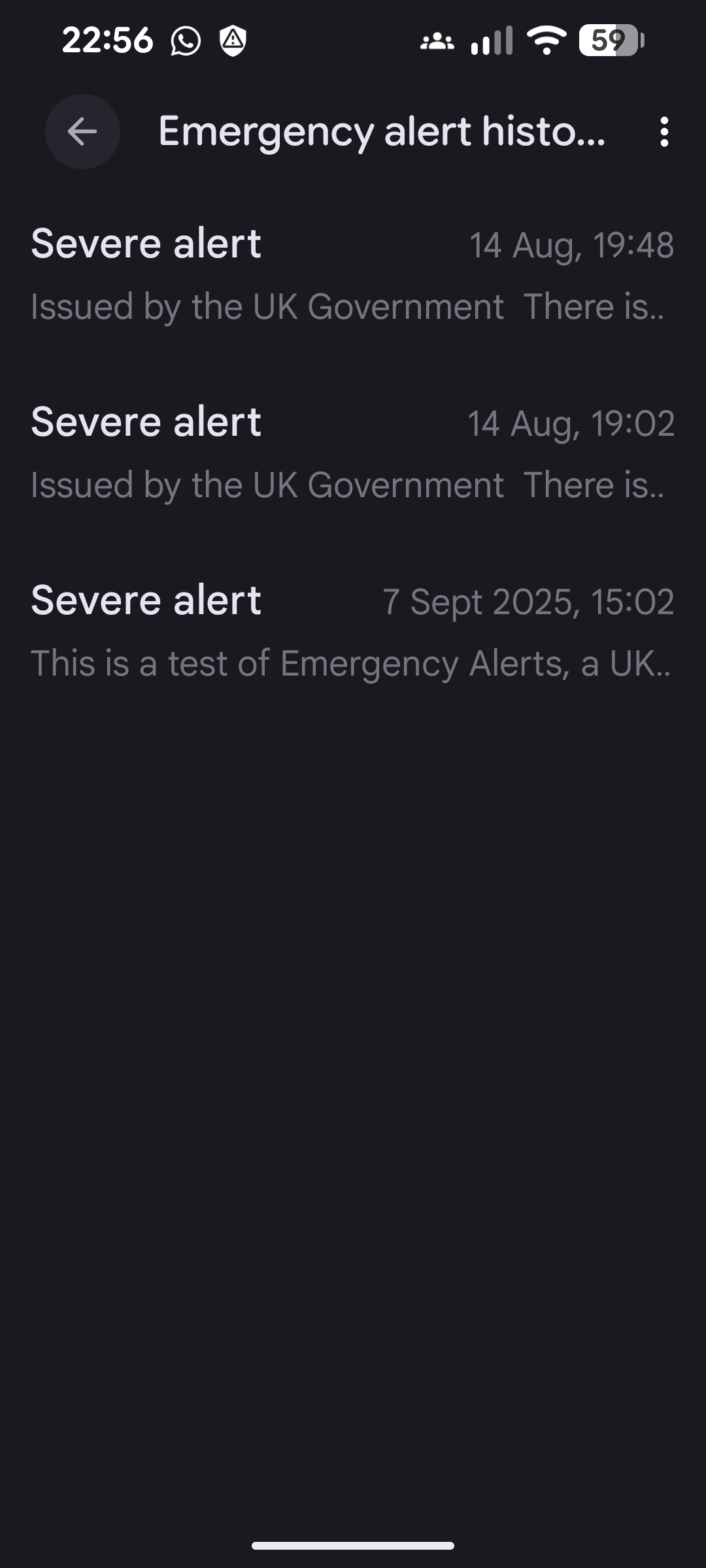
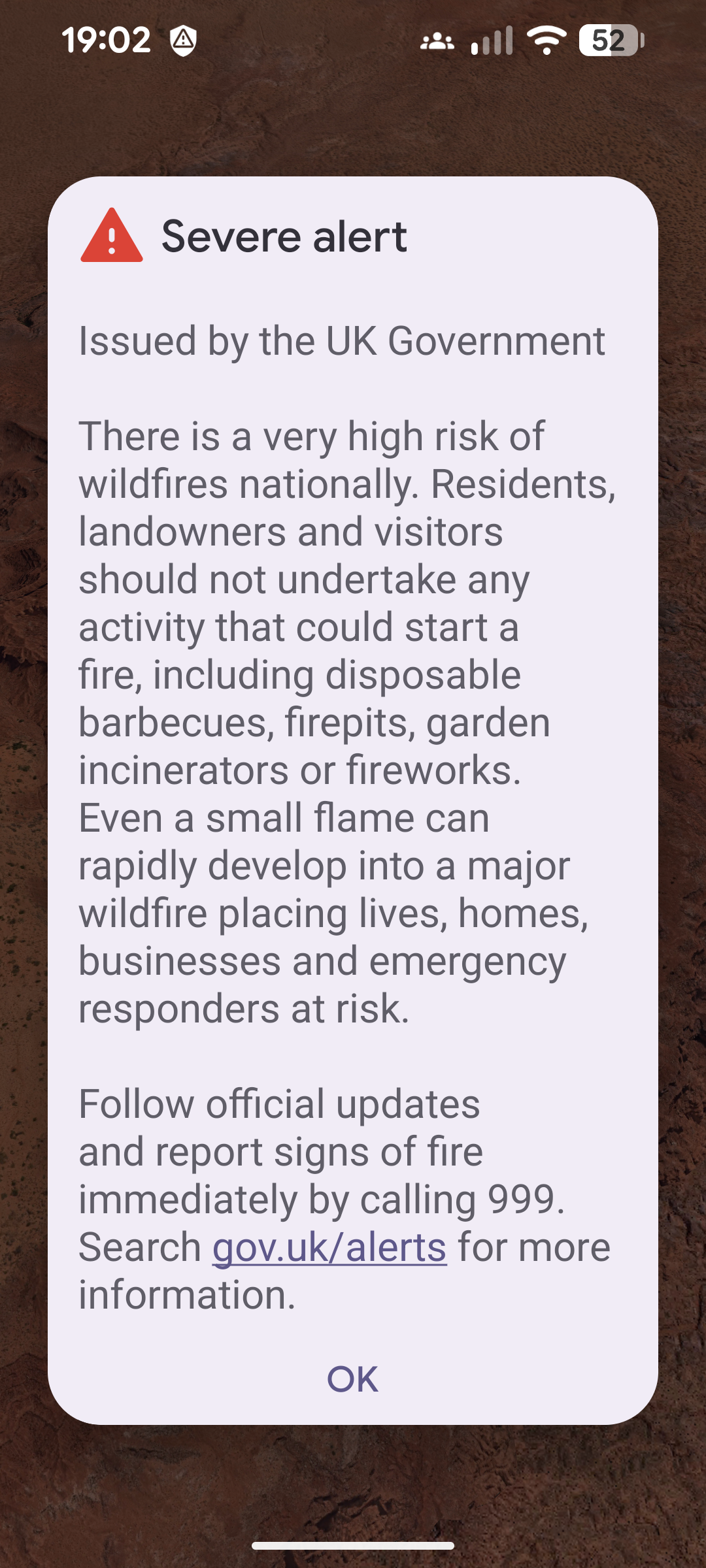
At 19:00 on 14 August 2026, the UK Emergency Alert system issued a severe alert broadcast nationally, marking a significant milestone in the operational history of the service. Confirmed by the official gov.uk/alerts platform, which recorded the last alert as sent at 7:01pm on Friday 14 August 2026, the activation represented the first time the system had been used to deliver a nationally broadcast severe weather behavioural warning to the public.
Alert Content and Public Guidance
The alert addressed an elevated national wildfire risk, providing the public with clear, actionable behavioural instructions. Recipients were warned against engaging in activities capable of igniting or spreading fire, specifically including the use of barbecues, firepits, incinerators, and fireworks. The messaging was direct and unambiguous, consistent with the system's design principle of delivering concise, life-safety-focused instructions to a mass audience simultaneously.
Members of the public were directed to call 999 in the event of an emergency and to consult gov.uk/alerts for further guidance and supporting information. This dual-channel approach, combining immediate telephony escalation with an online resource, reflects established best practice in emergency communications.
Operational and Policy Significance
The August 2026 activation carries considerable weight from an emergency management perspective. Prior activations of the UK Emergency Alert system had addressed discrete, geographically bounded incidents, such as the February 2024 Plymouth munitions alert. The August 2026 wildfire alert broke new ground by applying the severe alert tier to a diffuse, behaviour-driven environmental risk at national scale. For practitioners in emergency planning, resilience, and public communications, this activation establishes an important precedent, demonstrating the system's capacity to function as a proactive behavioural intervention tool rather than solely a reactive incident notification mechanism.
Implications for Emergency Management and Public Preparedness
The UK Emergency Alert system has matured significantly since its nationwide debut test on 23 April 2023, and its first live operational deployment in February 2024 - when residents near a discovered World War Two munition in Plymouth received an evacuation order - demonstrated both the system's practical value and the ongoing challenges of public compliance. For industry professionals operating in high-risk environments, understanding how the system performs under live conditions is now an operational necessity rather than an optional consideration.
Lessons from Testing and Live Deployment
The Plymouth activation provided a critical proof of concept, confirming that cell broadcast technology can deliver geographically targeted, time-sensitive instructions without requiring prior registration or location services from recipients. However, variable device compatibility and inconsistent public awareness of the alert format remain documented concerns. Professionals responsible for site safety planning should not assume universal device coverage within their workforce or visitor populations.
Integration with Existing Warning Channels
The government has been explicit that Emergency Alerts will not replace local news, radio, television, or social media. For emergency managers, this positions the mobile alert as the highest-urgency, first-contact layer within a broader, multi-channel communications framework. Effective preparedness strategies must account for all channels operating in concert, particularly for personnel who are deaf, hard of hearing, or otherwise reliant on accessibility features.
Responsibilities for Industry and Landowners
During high-risk periods such as severe flooding or wildfire conditions, landowners, site operators, and facilities managers carry a clear duty to supplement the alert system with site-specific protocols. Reliance on a single notification channel is insufficient. Designated response procedures, staff briefings, and coordination with local emergency services remain essential components of a compliant and effective preparedness posture.
Future Considerations
As the system matures, expanding alert categories beyond immediate life-threatening incidents and improving public understanding of appropriate response behaviours will be central priorities. Higher public compliance, clearer post-alert guidance, and broader device compatibility will collectively determine the long-term effectiveness of the UK Emergency Alert framework as a cornerstone of national resilience.